Sunday, December 17, 2017

Sicily: Opera dei Pupi: an Italian tradition you can still find


    Hundreds of eyes followed me as I explored the Museum di Pupi  (Antonio Pasqualino International Puppet Museum) in Palermo Italy.

An army of soldiers away the next battle

In 2008 The Unesco intangible heritage list of cultural traditions in danger of extinction, included the Opera dei Pupi, Sicilian puppet theatre.  Always searching for anything in Italy not listed in a tour book, Italian puppets of Sicily were on my list of must sees on my first trip to Sicily.


There are several locations in Sicily where the ancient craft is practiced: telling well-known stories with hand made puppets.  


The Kind and Queen stand with their guards

The Antonio Pasqualino International Puppet Museum building at Piazzetta Antonio Pasqualino, 5, Palermo has been re-purposed to a wonderful open space where the history of puppetry from many countries is celebrated with video examples of performances and original puppets.


But the heart of this museum features Italian pupi!   And they are everywhere.    Sorted by categories, just waiting to be called on stage, are soldiers, knights, monks, working people, animals and a few creatures that could easily slip into a horror movie!     You are able to walk among the racks of figures dressed in historic clothing  and they seem to follow you with their large eyes and ready to reach out and touch you.  


As you pass by or under one of the many hanging racks the pupi sway and their wooden feet or hands make a clicking sound that may make you walk a little faster. 


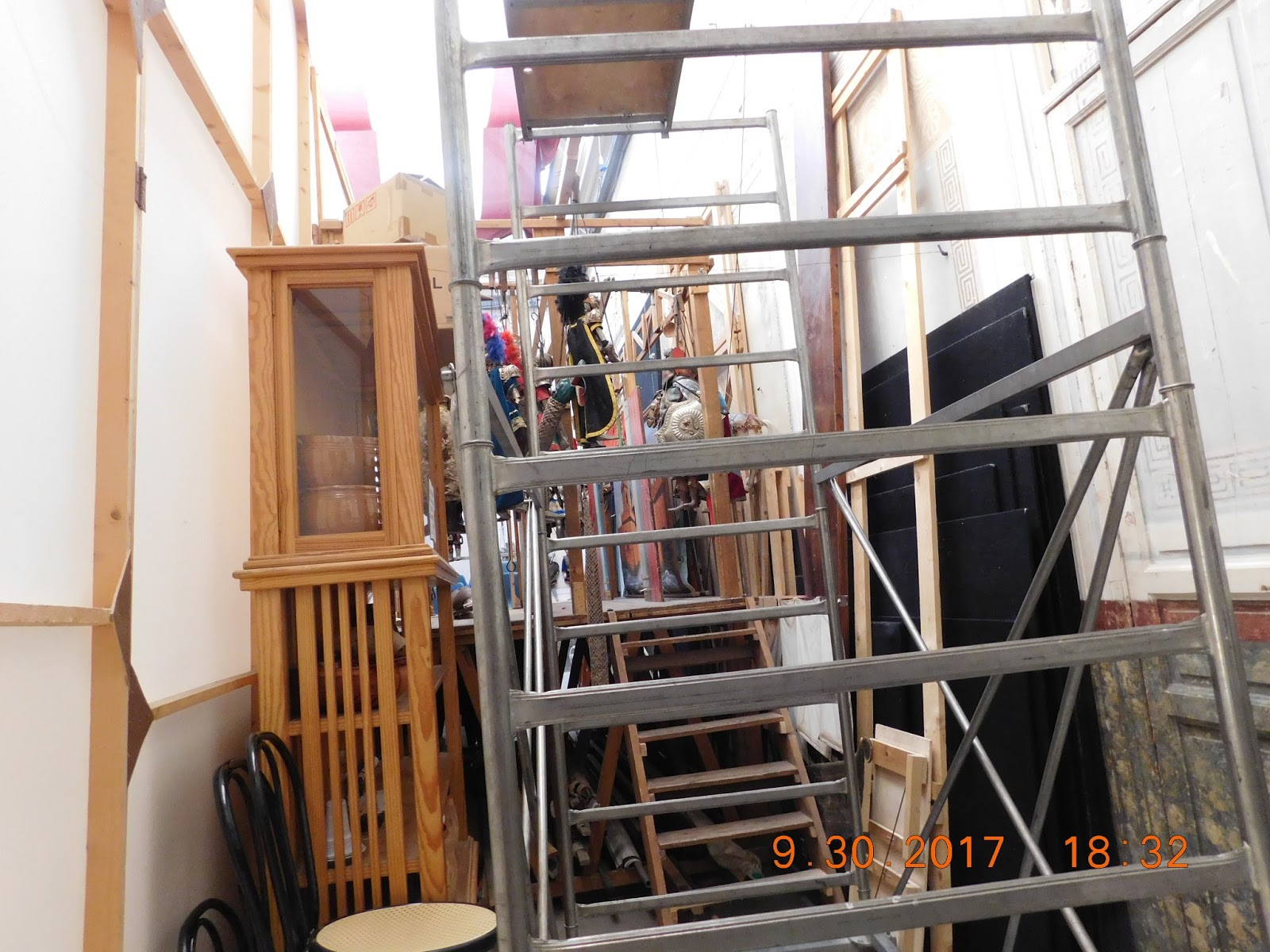
There is a full sized theater in the museum where shows are performed for school children and visitors.  I had to take a look behind the scenes to understand how a few handlers could manage a full production.   The space is very small with narrow boards running behind the stage on several levels.  Try to plan a visit when there is a live show to appreciate this art of storytelling.  


On the main floor there are theater/puppet based items and books.  Unfortunately there was nothing in English on the history of puppets so of course I turned to the Internet.   There are a wide assortment of puppets.1

The history of Sicilian puppets is extensive.   Puppet performances in the open squares of towns and villages or near or in the local church, entertained and educated the locals.  

Sicilian puppets are string puppets that have a central rod and strings attached to a control bar.   Sicilian puppets vary in size, much larger than hand puppets.  They are handmade of wood, painted and dressed in the characters period clothing.   The swords and armor is fashioned from metal, embellished with crests and designs.   Sicilian marionettes vary in size, in “Catania they are nearly twice the size of those used in Palermo” while Naples puppets are a meter tall.3

"A major component of the Opera dei Pupi is the sword fights, jousts and battles."  "The skill of the performer is shown in the action of the puppet as well as the improvised dialogue for the repeated themes of each performance." 2   

Puppet theatres were usually family run operations.   The skills of creating puppets and performing were handed down from one generation to another.   As other entertainment venues became popular, the number of puppet theaters diminished.  The Museo Internazionale delle Marionette works to preserve the long tradition of Sicilian pupi theater.  

There are several locations in Sicily that continue the historic practice of pupi: studios that create puppets, where collectors or travelers can find a hand crafted puppet to take home.   With advanced planning you can attend a traditional puppet show that recounts one of the historic stories with the famous characters:  Goffredo, Rinaldo and Orlando or Agricane.   A knowledge of the history of Sicily would be helpful when attending a performance. 
For centuries stories have been shared with the audience through the skills of Italian puppeteers.    Did you watch a performance at a local festa in your town?

www.facebook.com/museoantonio.pasqualino, 1.  https://en.Wikipedia.org/wiki/Puppet, 2. Sicilian Puppet Theatre-Opera dei Pupi/Italy, 3.  Lifeinitaly.com/tourism/sicily/sicily-puppet-theatre.asp
Email: mimap@museomarionettepale 
www.museodellemarionettepalermo.it
Facebook:  Museo Internazale Delle Marionette Antonio Pasqualino
References
1   https://en.Wikipedia.org/wiki/Puppet offers an extensive list of the different types of puppets from around the world.
2  Sicilian Puppet Theatre-Opera dei Pupi/Italy 
3.  http://www.historicgermany.travel/buy-products/best-value-packages


Wednesday, December 13, 2017

Another opportunity to renovate a home in an Italian village


Ever dreamed of owning a home in a pretty Italian village? The news you've been waiting for has finally arrived.
You can now buy one for just over a dollar.
 
Ollolai, a destination in the mountain region of Barbagia on the Mediterranean island of Sardinia, is selling hundreds of abandoned homes for just €1 ($1.2).
It's not the first Italian town to try the gimmick, but it seems to be the first to live up to the promise. It's also got the beauty and history needed to draw people in.
The real estate bonanza comes with a catch, though. The 200 stone-built dwellings up for grabs are in poor condition and buyers must commit to a refurbishment within three years -- which will likely cost about $25,000. 
Behind the sell-off is a plan to rejuvenate a community at risk of becoming a ghost town. In the past half century, Ollolai's population has shrunk from 2,250 to 1,300, with only a handful of babies born each year.
"We boast prehistoric origins," says Efisio Arbau, Ollolai's mayor. "My crusade is to rescue our unique traditions from falling into oblivion.
"Pride in our past is our strength. We've always been tough people and won't allow our town to die."
Read the full article here:
 

Tuesday, September 5, 2017

Florence: the children's home Ospedale degli Innocenti


More of the renovation has been completed 5/1/2017
 Florence, Italy

Ospedale degli Innocenti: the hospital of the innocents

Walking through the Piazza Santissima Annunziata as an exchange student many years ago, the imposing building on the east side of the piazza was never open, but it has proudly kept its long history of service to children.  


For the past year+ scaffolding and plastic sheathing has promised a renovation that will educate visitors on the buildings’ history.
The building style was unique for the 1400 and well documented in Wikipedia.

Now open to the public the ospedale innocente tells the story of the children left at the infants table (a circular platform that rotated to send the infant to the interior of the building) or older children brought to the ospedale when parents could no longer care for them.  Parents entrusted children to the ospedale until the family might be able to continue to care for them.

This window was where infants were left for the sisters to take in.  
      The infant had to fit within the grill work to be left here.   
                 

Other children were housed, fed and trained for skilled jobs when they reached maturity.   Girls might become nuns or marry since the organization supplied dowries for girls.   
Three floors are open to view for a small admission fee.   On the top floor is a large glassed wall café with outside seating to enjoy the rooftop views.   Off the cloister on the prima piano is a large meeting room and many other doors that were not open to visitors.   


On my second visit I found a new portion of the museum open for visitors.

                                                      The Museum

This is an interactive museum with audio, videos and text available in English as well as Italian.   A headset is an additional fee.  You can spend as much time as you wish at each exhibit. 
  
The bank of wooden drawers was captivating.


Each drawer was labeled with a child’s name and a date.  Inside is the original item a mother might have left with her child so that identification might be easier when a parent returned to claim their offspring.     Opening a drawer from more than 200 or 300 years ago, you find a ribbon or half of a medal (the parent would keep the other half) and other mementos that came to the ospedale with a child. 
I inspected dozens of boxes, some from the late 1800’s thinking of the mothers who left their children to be cared at the institute.

                                                                                                                                 
There is a note station nearby where you are asked to leave a message. Videos of several of former siblings of children adopted from the ospedale can also be played in English and explained how a family might bring a child from the ospedale home to join their other children.


                      Black and white photo show some of the children and workers, always formal photos. 
.

You could easily spend most of the day reading all the display entries, enjoying lunch in the café and viewing the extensive art exhibit also housed in the buildings.     I saw Italian tour guides with small groups in the museum but no mention of any scheduled tours.

The top floor art gallery houses pieces from very well-known artists.  The room is striking from an architectural view point.

A large gift shop is located on the first floor, free lockers at the entrances allow you to store handbags and back packs (free when I visited) and restrooms.  
There is a small Church within the ospedale but it is only open on Sundays for mass.  Perhaps on my next visit more of the interior is renovated that exhibits from the daily lives of the children and the caretakers will be on display: furniture, clothing, housewares and written accounts from the years the ospedale was open.  

Let your mind wander back hundreds of years and you are in Renaissance Florence.