Showing posts with label Venice. Show all posts

Wednesday, January 9, 2019

Venice: What do gondoliers wear on their feet?


What do gondoliers wear on their feet?   
 

When you think of Venice, the first thought may be the iconic gondola ride along the grand canal or on one of the quiet canals traversing the many islands that make up this city.   .  

You can enjoy watching the approximate 400  glossy black gondolas silently passing from the top of a bridge and on occasionally hear the echo of a gondolier serenade.


Gondoliers dress in the official ‘uniform’ of navy or red striped shirts, dark pants and often the iconic straw boater, according to Venice Insider.  An official clothing store at the foot of the Rialto bridge, Emillio Ceccato,   is where you can purchase authentic items.   When a number of gondoliers are clustered together, sight site is photo worthy!


You can usually find a group of gondoliers at one of the 'gondola stations' throughout Venice, waiting for the next passenger.  


Gondola Slippers:
On an earlier visit to Venice, Elizabeth Rainer, one of the three contributors to ‘My Pretty Venice’ a guide to finding Venice artisans and experiences (ISBN-10: 8873017746), introduced me to several of the artisans/shops included in the guide.  One of our stops was near the Rialto Bridge, S. Polo, # 60, to learn about the shoes sometimes called gondolier slippers or le furlane.                                                


My guide today, Elizabeth Rainer,
 a Venice expert


 .


S. Polo, 60   Rialto, Venice


When you enter this compact store, you are assailed by the riot of color from the floor to almost ceiling, cubicles holding furlane in linen, velvet and some novelty fabrics.  


Furlane in many colors and styles


Finding limited information about le furlane on line, some of the history is described on the web site for Piede a Terre.   The following is from parts of their web site:   

'As a result of the poverty and lack of employment just after WW II, the area of Friuli, north of Venice, began recycling old bicycle tires and jute sacks formerly used for seeds and grains.    The tire soles were waterproof and hard wearing.   The shoes evolved as other fabrics from old clothes and even rags were used for the uppers.'   


The simple slipper has expanded to wonderful fashion footwear

'Hand made by women in the area, they were perhaps the first recycled products!    The rubber soles proved long wearing, good for a sometimes wet surface and could protect the finish of a gondola, which is a very expensive boat.' 

It is not difficult to imagine women sitting in their homes homes producing slippers and using the proceeds from the sale of this simple product to supplement the family's income. 

Today you can find the slippers in several styles and many fabrics or bring your own fabric to have a pair custom made.   On this return trip to Venice I wanted to experience a pair of furlane.    I passed on a store off the main tourist route, selling a lovely selection because they were not made in Italy.     

Once I revisited Piede a Terre the problem was making a choice:  first the style, then the fabric and finally the color.    Furlane are made for men and children as well, so you might find all your gifts in one location.

A velvet slipper


Do gondoliers still use furlane?   

My search resulted in shoe-less, sneakers or trainers as you may call them and dress shoes, but I did not find any furlane.   Have you seen a gondolier wearing furlane? 


This gondolier chose to work in socks!


During my online search, I did find many things about  gondolas and gondoliers.  
Continue to read.
---------------------------------------------------------------------------------


Gondolas have been plying the waters around Venice for centuries.   After the introduction of the faster, motorized vaporetto, the need to use a gondola to travel the canals was reduced.   There may still be some privately owned gondolas (Peggy Guggenheim enjoyed a private boat and must have had her own boatman) but you find most of the 400 + remaining gondolas offering the unique experience to visitors. 

If you are brave enough to cross the grand canal standing up in a Traghetto with several other passengers, your experience may be somewhat different.    Not on my list of travel experiences.


A traghetto crossing the grand canal.   Credit:  bing.com images


To maintain and repair the working gondolas in Venice, there are a few remaining squeri (boat yards).   New gondolas are built by hand and can take approximately 2 months to construct, involving 8 different types of wood and assembling over 200 pieces! (see Veniceinsider.com)     

Perhaps the best know boat yard is the squero di San Trovaso, not far from St Marks square.   


                                      https://youtu.be/pmgKUKvdiqI

You can view the squero from across the canal.   If you are there at the right time you  may see a boat returning to the water after a repair.  click here  


How to obtain a license as a gondolier,  a short overview, far more information and details are available online.

The career of gondolier is usually handed down from father to son over the years.
First, a candidate must pass tests for rowing and swimming before continuing to the formal gondoliere school, a course lasting up to 18 months.   Gondoliers must know the history and geography of Venice as well as speak sufficient English.  

Exams must be passed before a student advances to a substitute gondolier assigned up to a year as a traghetti di parada, the cross canal passenger boats.  

Gondoliers had been a male only profession until 2010 when Giorgia Boscolo, the daughter of a gondolier,  passed the exam.   Again Venice Insider was my source for this information but several other articles have been published.    Chiara Curto has also been authorized to use a sandolo:  smaller and flatter than a Venetian row boat.

When you visit Venice try to notice the unique design of the asymmetrical gondola and how the gondolier stands to one side.   With practiced strokes the boatman can maneuver the 35+ foot long gondola around corners, around other boats and close to a stairway to embark passengers.  


A close up look at other gondolas:

A boat serves as a perfect neighborhood fruit and vegetable stall.   The locals stop by daily.


Perhaps the best known book store in Venice is Liberia Acqua Alta where a gondola is the center piece.


There is so much more on the history of Venetian gondolas so be sure to do an online search to learn more.

Although I appreciate your comments, promotional links will not be posted.    

If you need a response leave your email address.

For international visitors, please send comments translated to English.


All photos unless otherwise credited are the property of Home to Italy


Friday, April 27, 2018


Just saw this online.  I have heard locals in Venice talk for years about the problems with tourist and particularly the ones that come for the day or on a monster ship.   Now they have one solution, perhaps......


from Conde Nast Traveler
From April 28 to May 1, one of the biggest Italian holiday weekends of the year, tourists will be restricted from visiting popular landmarks like the Piazzale Roma and the Santiago Calatrava-designed Constitution Bridge. Unless you show a residential or commuter Venezia Unica pass at checkpoints, you're not getting through.


Tourists heading to Rialto or Piazza San Marco will be required to follow alternative routes, and can no longer walk the Strada Nuova, Venice's most famous boulevard. You and your car will be turned away at the lagoon if you don't have a pre-reserved parking spot in the city, and even the ferries will be adjusted, dropping passengers off at Fondamente Nuove, on the city's north side, rather than right in the middle of the action at Riva degli Schiavoni. Though these new policies and checkpoints are only in place for the weekend, Venice's mayor Luigi Brugnaro has also hinted that they could be periodically extended through the summer, Corriere della Sera, a Milanese newspaper, reports.
It's all part of Venice's self-preservation plan, to stave off the destructive effects of the 30 million tourists that visit each year. "We cannot prevent access to the city, and we do not want [to], but we must regulate the flow of tourists," Brugnaro said Thursday. The new restrictions are part of the city's "urgent measures to guarantee public safety, security and liveability," according to the mayor, and are likely a result of the thousands of tourists who descended on the city for Easter, when wait times for vaporetto water buses between Canal Grande, Santa Chiara, and San Marco were more than an hour.
photos from Hometoitaly.com blog

Tuesday, October 27, 2015

Venice: The Venician Beads are Speaking.....................


"Tuttifruttii" each bead is different


Click, Click ............. I hear this rhythmic sound as I walk with Marisa Convento in the residential neighborhood historically known for the 'bead stringers', the impiraresse.   


As the beads tap against each other, they produce a music. Marisa tells me she never leaves home without 'the beads' and the one time she forgot them, the beads had to be delivered to her!

Jewelry designers and bead historian: Marisa Convent
Photo from Italian Stories website
Click, Click, Click


 I met with Marisa on two different occasions during this trip to Italy. Although a very busy designer, she stopped her work to share with me her passion for Venice and the important history of Venetian glass beads.

This was a history lesson that wove a 'string' between international trade hundreds of years ago and how glass beads exported from Venice impacted the lives of Venetian women.  

Leaving the crowds to head towards the Arsenale.
  On my second visit,  Marisa met me near St Marks early one morning before the thousands of tourists arrived. We strolled along the lagoon towards the area of the Arsenale and the Biennale Pavilions. (note:  only St Marks is a square)
  
The landscape of Venice changes as you get away from the historic center. We passed shops that sold cheese, meats, the coffee roaster, a bakery, local Venetians supporting the residents in a world of large supermarkets.   Without my camera we could have been seen as two acquaintances out for a walk.

I have only been 'lost' in this part of the city once so I was happy to return with an expert. I love to watch Venetians transverse their city with ease, never looking at the few street signs, just knowing when to turn left or right.


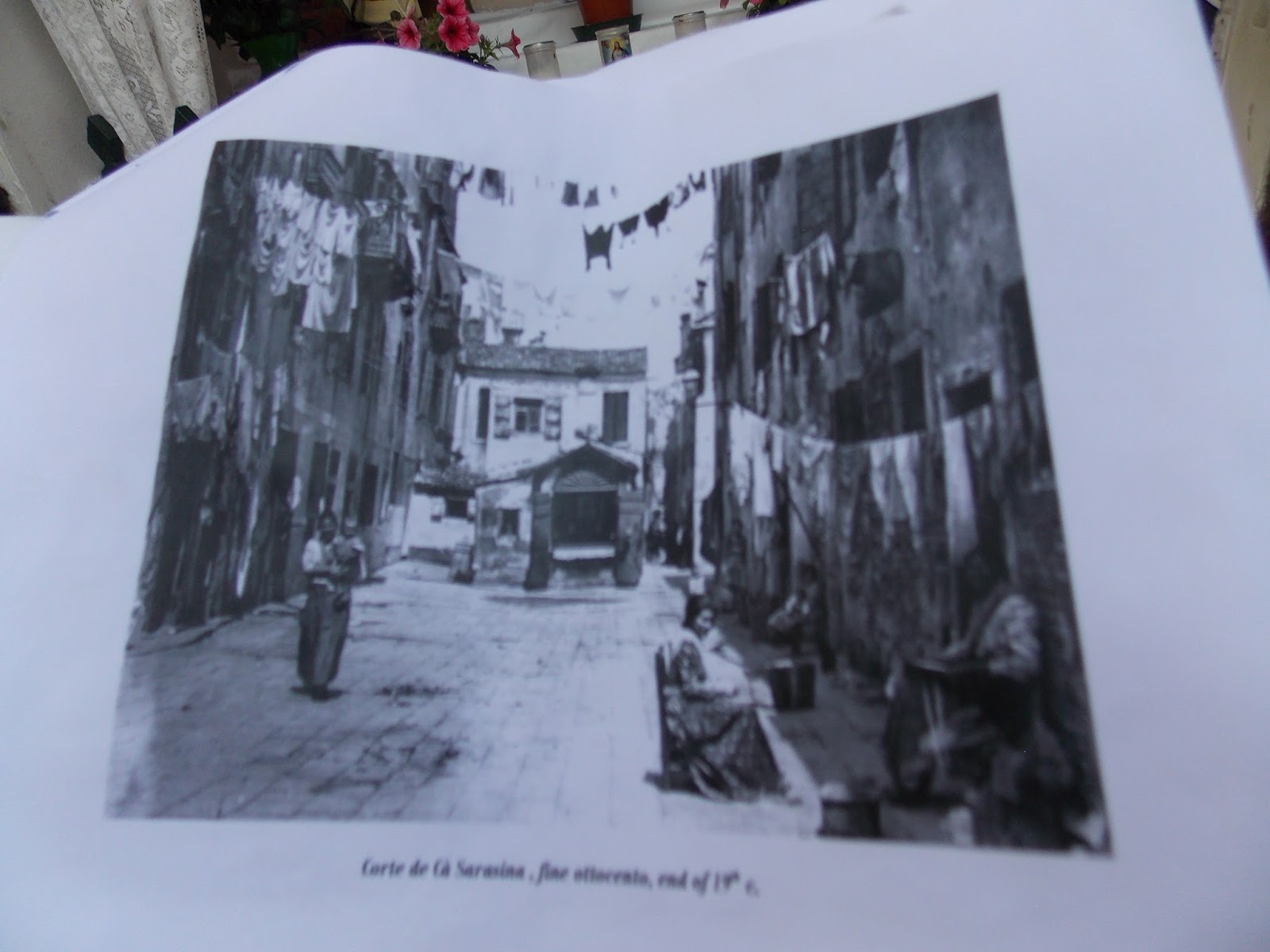
As we turned down one of the side streets everything changed. We were in the neighborhood where Venetians live. It was a hot sunny day so laundry was hung across every passageway, a colorful display of family flags!


The extreme heat wave hitting Venice this week, kept most of the locals walking on the shady side of the street and spending time in the massive park near this part of the island. Marisa had a great deal to show me and tell me about the 'bead stringers' in every campi (courtyard) we visited.  

Click, click, the beads continue to sing as we walk through the neighborhoods


The daily shopping for fresh fruits and vegetables is centrally located on a former boat parked in the canal at the center of the neighborhood. Not much has changed over the decades. The small campi in the neighborhoods are still the center of the community. 


A former city well now covered, sits in a prominent place within the neighborhood campo.   You will see these throughout Venice, some larger than others, some with intricate carvings and heavy metal lids.


  • Marisa explained that the women had to bring water to their homes twice a day for cooking, washing and laundry. Gathering at the well may have given them a few moments to chat while waiting to fill their buckets.   

      The women had large families and many exhausting duties        at home yet they still took on bead work for the small amount of money it would contribute to the family. 
            

More fascinating  to me were the corner shrines tucked into walls or over archways. We saw several and some had interesting stories. Each shrine is taken care of by an appointed neighbor. Flowers and lights embellish most of the shrines. One was totally renovated and the largest we saw that day had an interesting history.


One of the neighbors living a few doors from this shrine told us there is a communal prayer "Il Rosario di Maggio" service every week. Neighbors in this campo come together and pray the rosary.  They form a procession to visit other  shrines in the surrounding campi.  


Look closely and you will see the same shrine in this photo of the early 1900's that Marisa shared with me.   The women in the photo are 'bead stringers'.      

During my tour of the neighborhood that once housed many impiraressi, Marisa shared wonderful anecdotes about the strong guilds that were prominent in the area:   la pegola, the caulkers, those that worked with tar,  the carpenters who always carried  their tools with them, were 'on call' at any time for a repair and the rope makers, all guilds vital to the shipping industry.  Streets are even named after the trades the residents practiced.   


The neighborhood women spent whatever daylight hours that were not devoted to children or household chores, stringing the very small glass beads made in Murano.  

Above is a tray of seed beads and the multi needle tool that was passed through the tray of beads.  As the needles filled with beads they were passed down to the strings attached to the needles.    The more proficient the woman stringer, the more needles she used.  

Beads were easier to ship around the world when uniformally packaged in this way......another entire history lesson you shall hear when you join one of Marissa's tours.   (see below).

She will share the history and importance of the smallest of glass beads made in Murano, strung by hard working women, the beads that would be traded and used for ball dresses, costumes, beaded bags, beaded jewelry and flowers.


One of the original designs at Marissa's studio.  Photo from her web site

 On your next visit to Venice don't be a tourist, experience part of the life of Venezia.   Venice is a living museum that has much to tell you.  

All the great adventures listed below are available through:

Italian Stories www.italianstories.it

The Hidden Beads of Venice
Visit the secrets of the bead stringers
http://www.italianstories.it/en/ad/24/the-hidden-beads-of-venice

Beads in Family Workshop
A family friendly event that is a hands on experience
http://www.italianstories.it/en/ad/78/beads-in-family


Midnight Beads in Venice
An evening event that shows you Venice in a different 'light'
http://www.italianstories.it/en/ad/91/midnight-beads-in-venice


And you may hear the click of the beads


From Marisa Convento's web site

"My name is Marisa Convento, I am an Impiraressa, venetian traditional word for what I do: inventing  jewelery, embroidery, flowers and corals with fine venetian glass beads and rare vintage seed beads. My Venetian Dreams are strung for you and for the love of Venice, the city where I live, dream and work "

I was the guest of Marisa Convento, who I want to thank for her time and extensive knowledge of Venetian history.   Her passion for her art and her city is contagious.


Friday, August 21, 2015

Venezia: no words necessary


High Water